oil_from_algae : oil from algae: "Is it feasible to grow algae, harvest the oils, and use the algae oil for fuel? Discuss techniques, research results, and future directions. "Thanks to OfA group moderator (?) Tom Catino for the heads-up on this one.
Tuesday, September 19, 2006
Oil from Algae?
Ever wondered if you could get OIL from ALGAE? Do you wonder now that I mentioned it? Check out the "Oil From Algae" Yahoo Group described below:


Wednesday, June 14, 2006
Algae returns to Great Lakes
Algae returns to Great Lakes: "Algae returns to Great Lakes
By JOHN FLESHER, Associated Press Writer
TRAVERSE CITY, Mich. - Call it the return of the green slime.
By JOHN FLESHER, Associated Press Writer
TRAVERSE CITY, Mich. - Call it the return of the green slime.
Back in the 1960s, foul gobs of algae along Great Lakes shorelines made swimmers and sunbathers miserable before a crackdown on phosphorus pollution repelled the invasion.
Now, the algae are mounting a comeback and controlling it may be tougher this time, according to the Michigan Environmental Council, an umbrella organization for a host of environmental and public interest organizations in the state.
'The nightmare may be poised to repeat itself,' the council said in a statement accompanying a report released Wednesday.
Algae blooms have been on the rise since the mid-1990s in parts of all of the Great Lakes except Lake Superior, whose icy waters are not as hospitable to the slimy aquatic plants."
Tuesday, February 28, 2006
Where can you find the Image Library Images?
Images from Michael R. Martin's Phytoplankton Image Library have been used in an odd diversity of places. Here is one example:
Hayden Planetarium
Rose Center for Earth and Space
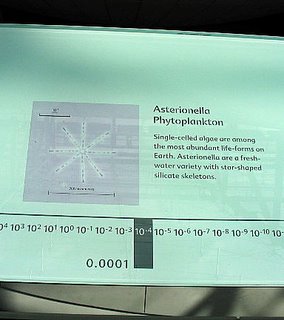


So, next time you are in NYC . . .
Hayden Planetarium
Rose Center for Earth and Space
The Rose Center's Scales of the Universe walkway hugs the glass walls of the Rose Center and features differently scaled models that illustrate the relative size of cosmic and human objects, from galaxies, stars and planets, to the human brain and nucleus of the smallest atom. The 400-foot long walkway ingeniously uses the Hayden Sphere for size comparison.One of my Asterionella images is used to show the scale of things at 0.0001. And here are pictures of that very image in place, with my suitably impressed sister and nephew striking a pose.
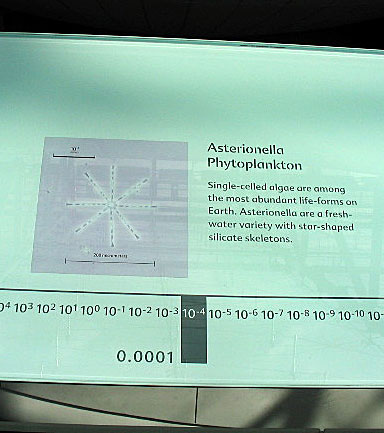


So, next time you are in NYC . . .
Thursday, February 23, 2006
Saving the Earth can also bring profit to startups
Saving the Earth can also bring profit to startups: "startup Planktos plans to create huge algae blooms at sea that will suck some of the greenhouse gas out of the atmosphere, then sell credits to European companies unable to meet their emissions targets.
Those companies would, in essence, pay Planktos to take out of the air carbon dioxide they are putting in. Should California, New York or other American states adopt similar cap-and-trade systems, Planktos would sell here, too.
Russ George of Planktos belongs to a small but growing group of entrepreneurs trying to turn carbon dioxide limits into business plans. Spurred by the Kyoto Protocol that mandated greenhouse gas reductions in Europe and Japan, they are dreaming up products and services they can sell to companies that take advantage of cap-and-trade systems.
Like many in the nascent field, Planktos is still in its early stages. George and his colleagues are running offshore tests to see if they can reliably produce the size of phytoplankton blooms they want, using ground-up iron ore to stimulate growth. They also are starting a forest restoration project in Hungary to remove carbon dioxide from the air. The company generated enough interest that Vancouver's Solar Energy Ltd. bought it last year for "
Those companies would, in essence, pay Planktos to take out of the air carbon dioxide they are putting in. Should California, New York or other American states adopt similar cap-and-trade systems, Planktos would sell here, too.
Russ George of Planktos belongs to a small but growing group of entrepreneurs trying to turn carbon dioxide limits into business plans. Spurred by the Kyoto Protocol that mandated greenhouse gas reductions in Europe and Japan, they are dreaming up products and services they can sell to companies that take advantage of cap-and-trade systems.
Like many in the nascent field, Planktos is still in its early stages. George and his colleagues are running offshore tests to see if they can reliably produce the size of phytoplankton blooms they want, using ground-up iron ore to stimulate growth. They also are starting a forest restoration project in Hungary to remove carbon dioxide from the air. The company generated enough interest that Vancouver's Solar Energy Ltd. bought it last year for "
Mutant Algae Is Hydrogen Factory
Wired News:: "Mutant Algae Is Hydrogen Factory"
Researchers at the University of California at Berkeley have engineered a strain of pond scum that could, with further refinements, produce vast amounts of hydrogen through photosynthesis.
The work, led by plant physiologist Tasios Melis, is so far unpublished. But if it proves correct, it would mean a major breakthrough in using algae as an industrial factory, not only for hydrogen, but for a wide range of products, from biodiesel to cosmetics. . . .
Subscribe to:
Posts (Atom)